
TETRA Receiver, 380–385 MHz
A dedicated superheterodyne receiver tuned to the TETRA band every UK emergency service uses. It hears the signal, measures its strength and tells you how close the source is.
A compact receiver for your windscreen that hears police, ambulance and fire service radio up to 1 km away, and warns you before you ever see them.
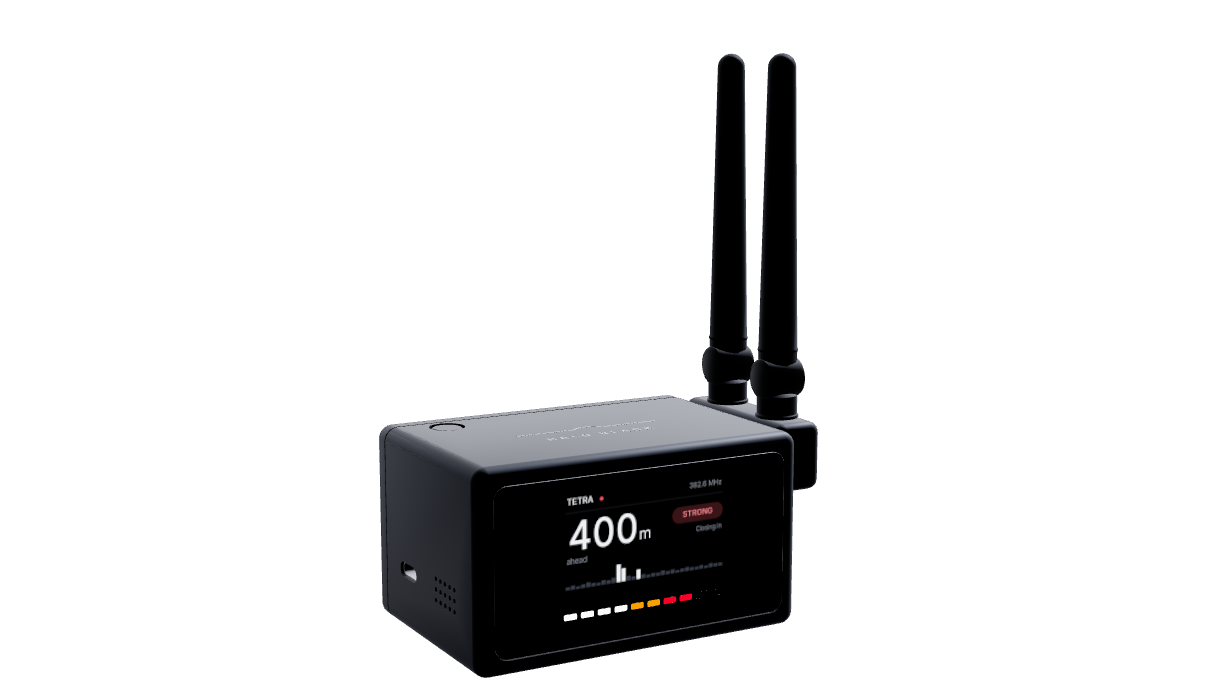
Halo Black is a purpose-built passive receiver that detects emergency vehicle radio up to a kilometre before the vehicle comes into view. It doesn't transmit. It doesn't decode anything. It simply tells you something is there, and how close it's getting.
How It WorksA custom-designed receiver built for one job: hearing what's on the road around you before you can see it.
A dedicated superheterodyne receiver tuned to the TETRA band every UK emergency service uses. It hears the signal, measures its strength and tells you how close the source is.
Police body cameras broadcast a Bluetooth signal. Your phone hears it at about 50 metres; the detector's Coded PHY radio and external antenna reach up to 300.
By the time you see a patrol car, you're already past the point of doing anything about it. Halo Black hears them long before that.
Open road8–10 football pitches800 m – 1 km+
Suburban road5 football pitches500 m+
Built-up urban3 football pitches300 m+
Your eyesA marked car, straight road200–300 m
Terrain, buildings and weather affect range. In built-up areas 300–500 metres is typical: still well past what you can see round bends, over hills and through junctions.
Six times the body camera range of your phone alone. That's the difference between spotting a camera as you drive past it and knowing about it three streets before you get there.
On a straight dual carriageway you might spot a marked patrol car 200–300 metres ahead. An unmarked car you won't see at all. The detector doesn't care whether a car is marked. It hears the radio.
Mount it. Power it. Drive. Out of the box it's a proximity alert with no phone, no app and no account. When it picks up TETRA or Bluetooth activity:
Best for: basic awareness with zero faff. No phone mount, no screen to look at.
Pair it with the free Halo Black app over Bluetooth and everything it hears reaches your phone as it happens.
Best for: the complete picture, and navigation that knows about all of it.
The Target Blu Eye has been the go-to emergency vehicle detector for years. It detects TETRA transmissions and alerts the driver. It works. It also costs £1,249 to £1,449 at UK retailers, plus fitting.
Emergency vehicle detectors have been a niche market with one dominant player and no price pressure. Halo Black builds the same core detection with more detection types and a connected app, without the luxury markup. Every driver should be able to afford awareness on the road, not just those willing to pay four figures.
Every alert is scored weak, probable or strong, so you know how much weight to give it.
The detector listens to 380–385 MHz. It detects that a transmission is there and measures its strength. It never decodes voice or data.
Axon body-worn cameras broadcast a Bluetooth Low Energy signal. Your phone hears it at about 50 metres; the detector pushes that to 300.
Drivers report patrol cars, speed vans and roadside checks in one tap. Reports from detector owners are verified automatically.
The Halo Black Detector is a receiver. It listens to signals that are already in the air around you. It does not:
It notices that a signal is there and measures how strong it is. That's all. Detectors that work this way, such as the Target Blu Eye, have been sold and fitted in the UK for more than a decade.
Live band TETRAdB above noise
| Time | Freq | Level | Evidence |
|---|---|---|---|
| 21:42:07 | 382.6 | +18 dB | Strong |
| 21:41:52 | 382.8 | +11 dB | Probable |
| 21:39:15 | 383.9 | +6 dB | Weak |
TETRA is the earliest warning on the road, but a radio only transmits when someone uses it. When the channel goes quiet, an emergency vehicle can be right behind you and send out nothing at all.
So the detector doesn't rely on radio alone. Our own pattern detection, found only in Halo Black, listens for police body cameras over Bluetooth. They keep broadcasting whether anyone is talking or not, so when the radio goes silent, the detector is still listening.
No chatter means no TETRA burst, even with an emergency vehicle close by.
Body cameras broadcast all the time. Our pattern detection matches them against known devices and picks them out of the crowd.
Both feed the same alert, so a quiet vehicle still shows on your screen and sounds through your speakers.
Only in Halo Black. TETRA's one weak spot, fixed.
A full UK sat nav with live police alerts. Use it without the detector now; get more from it when the detector arrives.
Android now. iPhone, CarPlay and Android Auto are planned. Google Play listing coming soon.
A compact passive radio receiver for your windscreen, with one antenna for the TETRA band and one for extended-range Bluetooth. It alerts you through its own LED and buzzer, or through the free app with maps and voice.
Because it listens for two different things. Emergency service radio (TETRA, 380–385 MHz) and police body cameras (Bluetooth, 2.4 GHz) are more than six times apart in frequency, and an antenna only works well at the frequency it's built for. With one antenna each, both receivers get full range and both listen at the same time.
No. It works standalone with LED and buzzer alerts. Pairing it with the free app adds mapping, voice alerts, navigation, confidence scoring and community features.
Blu Eye detects TETRA only and costs £1,249 to £1,449 plus fitting. Halo Black adds police body cameras and a free sat nav app, works standalone or connected, and fits with a suction mount.
It's receive-only: it doesn't transmit, decode or interfere with anything. That's how the Target Blu Eye works too, and it has been sold in the UK for more than a decade.
A suction cup with a ball joint, like a dashcam or sat nav mount, powered by USB-C from your car.
The rest of what people ask us: how alerts are scored, which phones the app runs on, what it costs to keep using, and when the detector ships.
Email UsHow sure the evidence engine is, from signal strength, frequency, transmission pattern and known device signatures. Weak stays on screen; probable and strong are spoken. You choose which levels speak.
Fixed and average speed cameras come from a mapped database, and the app will include them. The real value is live, moving, unmarked emergency vehicles that no database shows.
Android now. iPhone, CarPlay and Android Auto are planned.
No. The app is free and the detector is a one-time purchase. No monthly fees, no premium tiers, no paid upgrade.
A numbered run of 25 Founder Edition prototypes, hand-assembled in a 3D-printed case, is on sale in the shop. For the production detector, join the waitlist: one email when it ships, nothing else.